Upega, bread under the stone arch
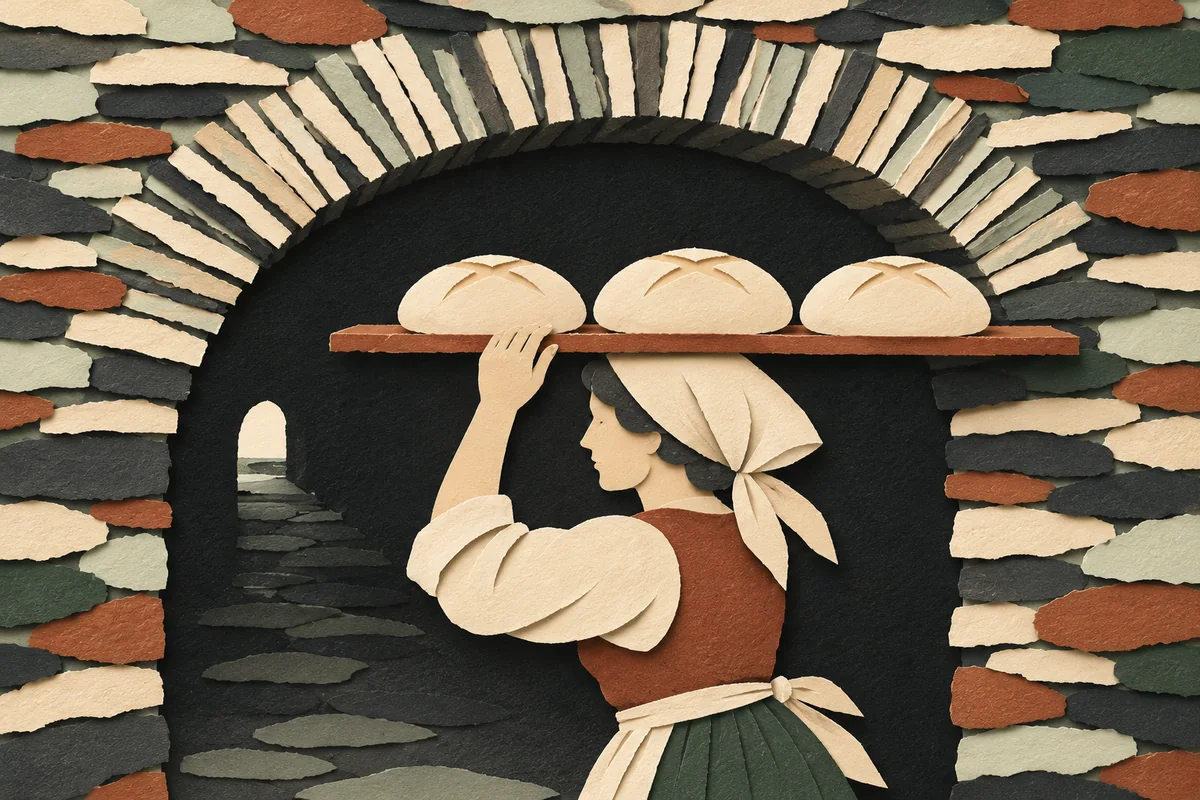
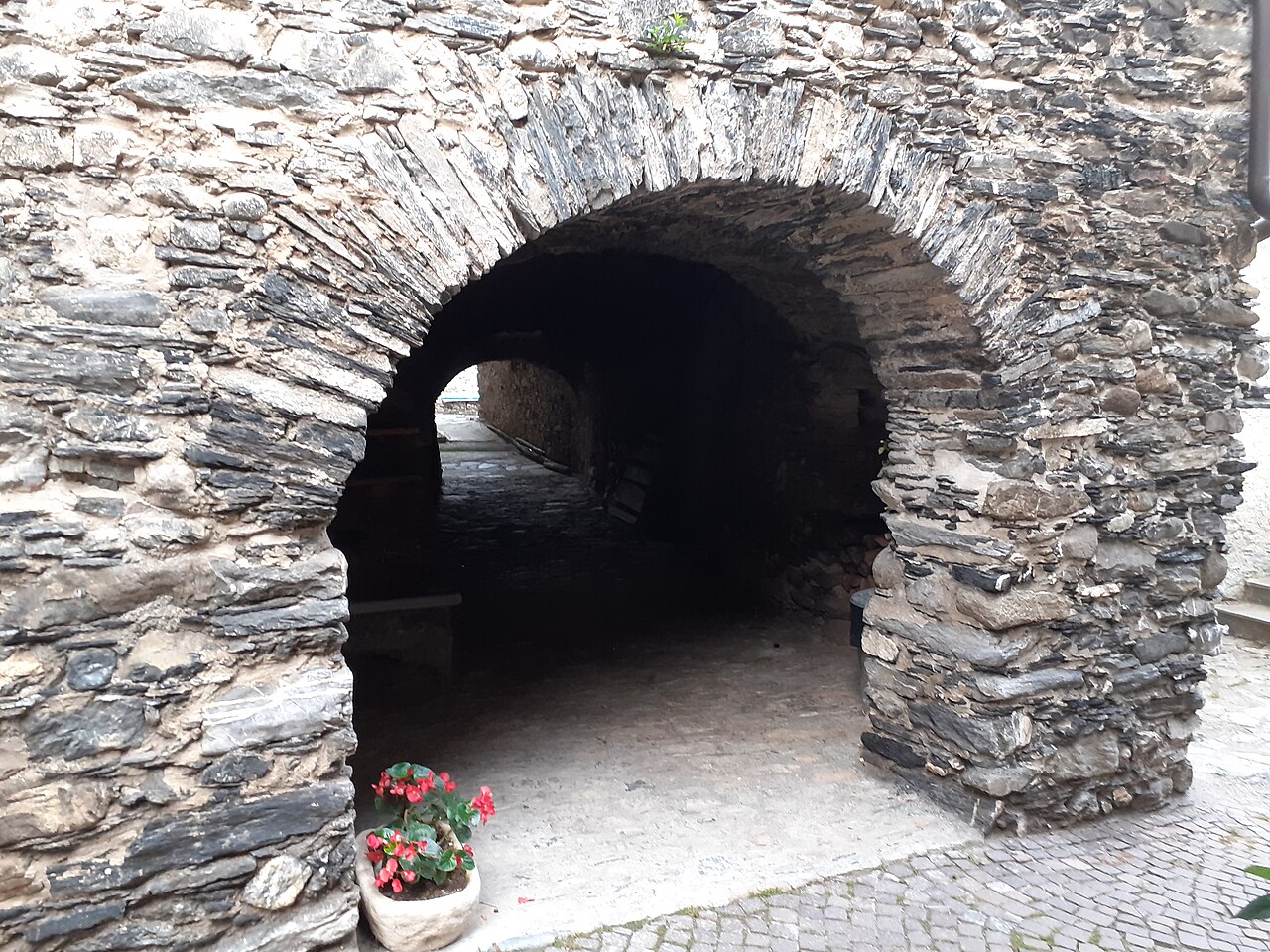
To book Upega’s big oven, you left two pieces of firewood crossed inside it. The women arrived at the stone arcade in the Sutàn, the lower part of the village, balancing the unbaked loaves on a board on their heads. The oven was free to use. Families shared the firewood and marked their own dough so they could tell the loaves apart when they came out. Upega’s Pro Loco association dates the oven to the first half of the nineteenth century. When it needed repairs, there was a smaller one uphill. After some forty years out of use, the main oven was brought back into service in August 2015 by volunteers and the local landowners’ association.
Look up as you leave the arch. Upega stands at 1,297 metres, where the Corvo and Žnìgë streams meet the Negrone. On the narrow strip of land between the water and the hillside, the houses grew upwards. Several tiers of wooden balconies, called puntìi, can run up a single façade. Above the last balcony there was often a single roof slope covered in ciape, slabs of local stone. Sheet metal has since replaced much of the stone.
One tall house has a story of its own. The Pro Loco calls it a cà di sinquë cian, the five-storey house. Bartolomeo Lanteri (1827–1878) had four daughters and five sons. He went to France for seasonal work. The story told in Upega is that he came home each spring and built a floor for one of his boys. One of his daughters ran a grocery and tobacco shop on the top floor. Walk around the house to see how customers reached it. The fifth storey counting from Via Antonio Lanteri is at street level on Via IV Novembre.
A place to work out of the weather
A second covered space on Via Santa Lucia is called the Balàndura dër Marchisùn. Until the 1950s this was where you brought a knife to be sharpened or a copper pot to be mended by an itinerant craftsman. People sold cloth and weighed livestock under the same shelter. At the communal mill, water drove a horizontal wheel connected straight to the millstones. A winch and wooden pulleys lifted the stone when it needed moving. The Pro Loco has photographs of the building in the 1970s and in 2024, as well as one of the milling gear. They give you a look inside even when the door is shut.
The names on the memorial
In October 1944 Silvio Bonfante, a factory worker from Oneglia whose partisan name was Cion, was wounded in the leg at Vessalico. Federico Manera’s account for the Mendatica Pro Loco places him in the partisan hospital at Valcona Sottana, on Mendatica’s side of the mountains. As German forces closed in, the wounded were moved to Upega. The two villages mark the ends of the stretcher journey. The surviving accounts cited here leave the precise path unknown.
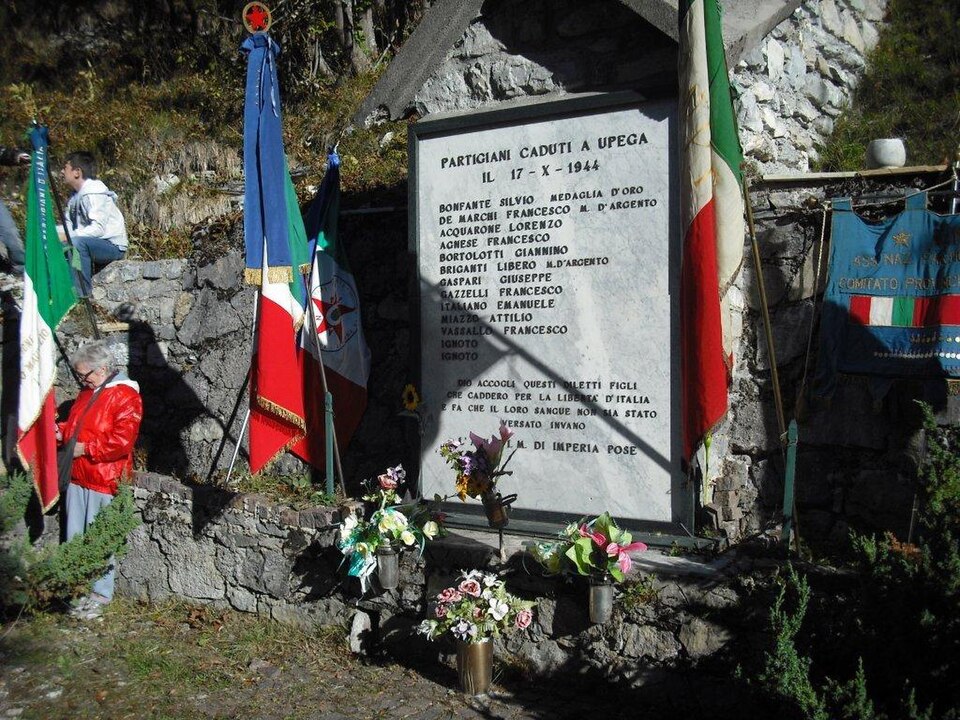
German troops attacked Upega on 17 October. ANPI, the Italian partisans’ association, describes a doctor and several men trying to carry the most seriously wounded to safety. Bonfante took his own life when the party was surrounded. The Mendatica account dwells on his wish to spare the stretcher bearers. His posthumous citation mentions both the danger to those helping him and the prospect of capture. His name appears beside those of the other dead on Upega’s memorial.
Coming up the Tanaro valley
Upega belongs to Briga Alta in Piedmont, along with Piaggia and the two settlements of Carnino. From Ponte di Nava take the SP154 past Viozene and leave the Carnino turning on your right. The road runs through the narrow Fascette gorge before it reaches Upega. Sant’Anna, the parish church consecrated in 1801, is a village landmark at 44.12891° N, 7.72674° E. For a visit inside the mill, ask the Pro Loco at 11 Via Provinciale about exhibitions and opening dates.
In the open season, the route from Mendatica comes over San Bernardo and through Piaggia and Le Salse to the Colletta pass. The two provinces closed the pass for winter 2026–27 on 9 November. On the Cuneo side the closure starts at kilometre 17 on the SP154 by Upega. During the closure, approach from Ponte di Nava and return the same way.
Sources and visitor information
- Upega Pro Loco, six village stops and the mill photographs
- Upega Pro Loco on booking the oven and its return to use in 2015 · Bartolomeo Lanteri’s house
- Briga Alta municipality on the streams, roofs and balconies
- Federico Manera on Bonfante at Valcona Sottana
- ANPI biography and Bonfante’s medal citation
- Sant’Anna on the map
- Province of Cuneo, SP154 beyond Upega
- Province of Imperia, closure on the Le Salse approach
- Valcona Sottana and the field hospital · The turning for Carnino
- Source notes
Photographs and credits
The arcade of the Sutàn bread oven from the lane, Arbenganese, 24 August 2022. Full frame, resized to 1,280 × 960 pixels. Original photograph · CC BY-SA 4.0

Memorial to the fallen at Upega, Fioravante Patrone, 18 October 2012. Full frame, resized to 960 × 720 pixels. Original photograph · CC BY-SA 3.0

Cover. Carrying bread to the oven on a board, a custom recorded by Upega’s Pro Loco. Interpretation made with ImageGen. The arch is adapted from Arbenganese’s photograph, 24 August 2022. Photograph and adaptation are licensed under CC BY-SA 4.0.