Mendatica village, from the church steps to the watermill
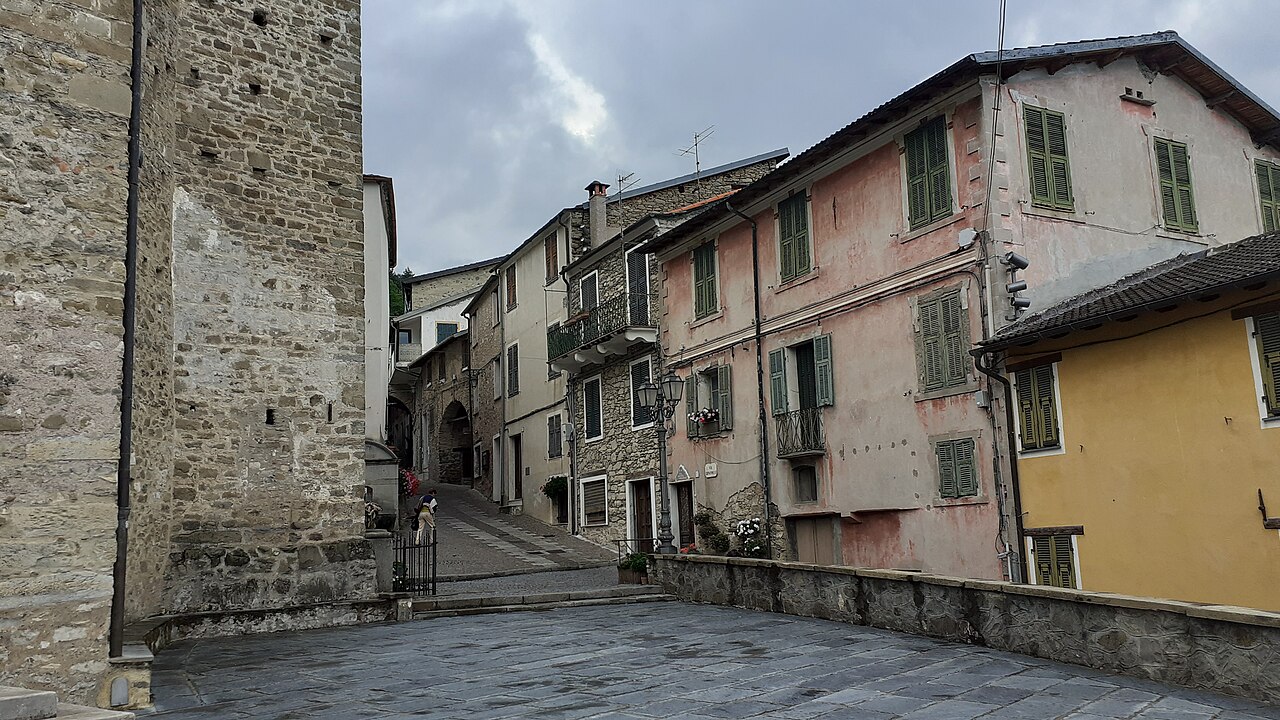
Stand at the foot of the church steps in Piazza Roma and you are at what used to be the far end of the church. The medieval apse stood here. Worshippers entered from the opposite end, where the choir is today. The parish of Santi Nazario e Celso tells the story from research by Celestino Lanteri and Emilia Lantrua. The bell tower survived the eighteenth-century rebuilding. So did the little lamb carrying a banner, now set into the façade above the square. People in Mendatica call it l’agnello di San Giovanni, Saint John’s lamb.
The town hall at No. 1 serves a string of mountain settlements as well as the village. In the 2021 census, 144 of the municipality’s 162 residents lived here, 778 metres above sea level in the upper Arroscia valley. One former deputy mayor, Italo Porro, spoke to the weekly Trucioli around his ninetieth birthday. As a boy he knew the village trattorias as his father’s customers. They bought the wine his father made. In 1966 Italo gave up his seat at the town hall to take a job with the Autostrada dei Fiori motorway company.
The fountain on Via Mazzini
Follow Via Mazzini uphill from the church. One of the carved stone fountains in the upper village was still doing service as an address in 2021. When an outdoor supper was announced at No. 42, the directions placed it simply “near the fountain”. The writer Gabriele Desiderio had noticed something about Mendatica’s public fountains in 2007. There were no taps to turn off, so the water kept running.
Local writer Pietro Porro remembered the springs around Mendatica flowing freely even in dry summers. In the village’s dialect name he heard the Italian words manda acqua, “sends water”. The Ligurian Alps park plan records another possible origin, an ancient personal name, Mendus. In August 2021, the summer of the supper on Via Mazzini, drought led the mayor to restrict drinking water to food and hygiene uses.
Carrying water home
Back near the church, Via Giovanni XXIII leads to the Vecchie Prigioni, the old lock-up. In the sixteenth century its two cells held people waiting to appear before the court at Pieve di Teco, down the valley. The things kept here now came from local homes. There are shoes, lanterns and even inkwells.
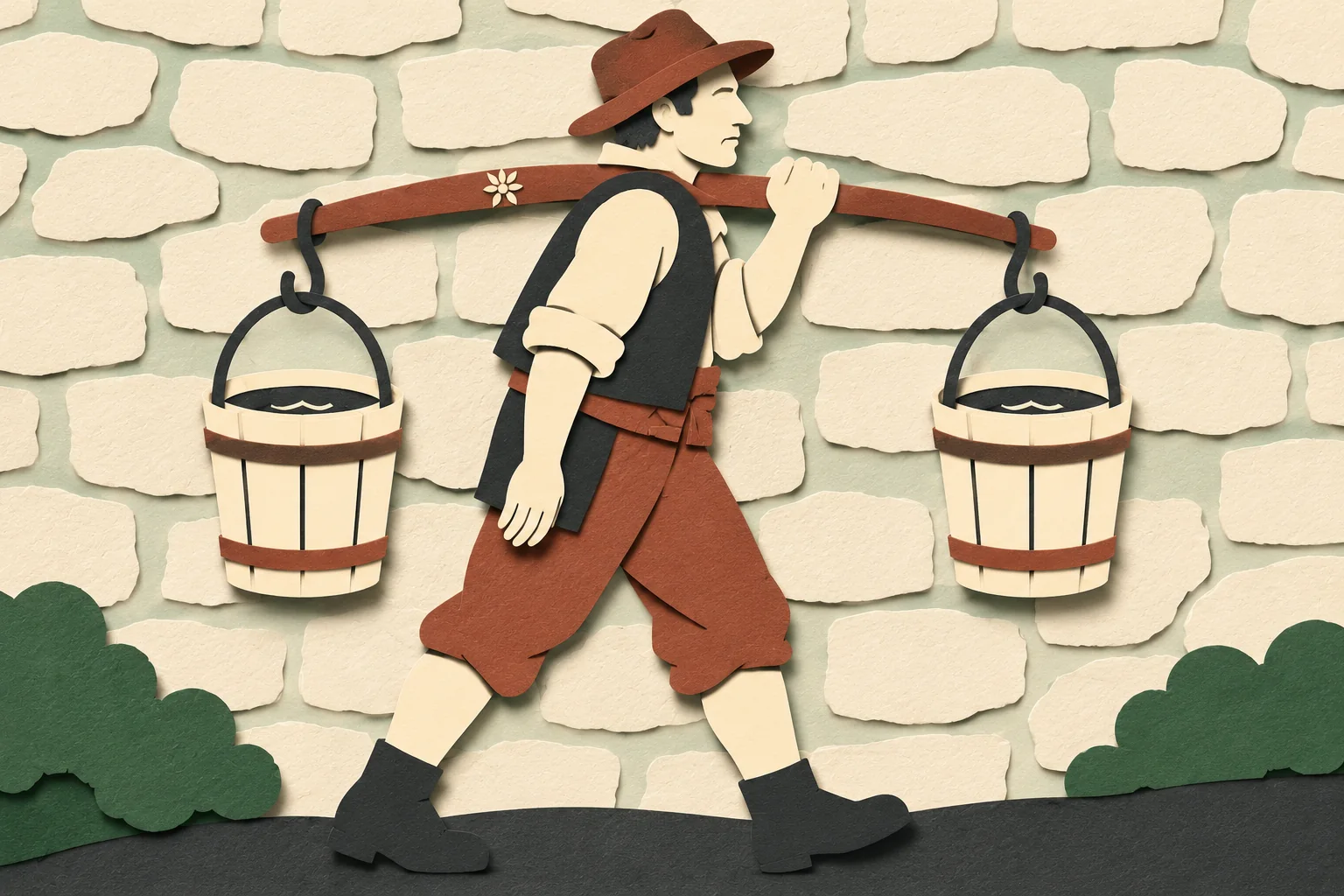
At No. 2 Via Madonnetta, the Casa del Pastore, or Shepherd’s House, takes up the story where the fountains leave off. Among the pieces from Rino Lanteri’s collection is a bilanciere, a curved wooden carrying pole a metre and thirty centimetres long. A bucket of water or milk hung from the iron hook at either end. With the weights roughly matched, the carrier could lift both on one shoulder. Someone took the trouble to carve a six-petalled edelweiss into the wood.
The museum brings the rooms of a malga down into the village. Local families spent their summers with their animals in these small upland settlements. The stable downstairs holds the tools for tending livestock and turning milk into cheese. A stone and timber stair leads to the family quarters upstairs. A fire burned in the middle of the kitchen. The family slept in the room alongside.
The mill in the Christmas crib
For the mill, leave the village centre and head towards Pieve di Teco. The site is beside the Arroscia at kilometre 6 on the SP3. The villagers had the mill built in the sixteenth century. Photographs taken before the flood of 2020 show how a sack of grain made its way through it. The miller tipped the grain into a wooden hopper above two millstones. Water turned the wheel outside, gears drove the upper stone, and grooves carried the ground meal out to the rim. Upstairs were the windows of the miller’s living quarters.
That December, the parish found a way of showing what the flood had meant. Around the Nativity in the village church it set the little cascades of Le Canalette, a fountain with a trickle of water, and a mill that stood still. Down by the real stream the building was full of mud and debris. Residents and local associations spent a month clearing it. On 30 March 2026, Rai reporter Lucia Pescio spoke to Mayor Graziano Floccia, Mariella Pelassa of the local Pro Loco association and Celestino Lanteri, the historian who had helped trace the lamb on the church façade. The mill was ready to reopen. The regional heritage office paired it with the Shepherd’s House for a visit scheduled for 30 August.
Planning a visit. The square, Via Mazzini and the fountains are part of a walk through the village streets. For more on the herders’ seasonal journeys, look for the open-air museum. Its panels line a caruggio, the Ligurian word for a narrow lane. The natural history collection introduces the animals of the valley. The map room near the sports ground holds reproductions from archives in Turin, Genoa and Nice.
The Pro Loco takes bookings for guided visits. Give the tourist office your date to arrange a visit to the cells and the Shepherd’s House, and ask whether the mill and the map room will be open. The number is +39 338 3045512, also on WhatsApp. If steps are difficult, ask which rooms you can reach.
Sources and visitor information
- The parish on the lamb above the church steps and the Christmas crib of 2020.
- Trucioli on Italo Porro’s memories and Pietro Porro, the Via Mazzini fountain and the drought.
- The Italian heritage catalogue entry for the carrying pole and the Pro Loco’s museum guide and booking form.
- Photographs of the mill before the flood, Lucia Pescio’s report for Rai and the regional heritage office’s August itinerary.
-
Full source notes, including the park publications and census figures.
-
Explore further · Santi Nazario e Celso, the bell that called the builders · The Shepherd’s House and the pail held between the knees
Photographs and credits
Ciassa da gêxa (Mendàiga)-Vista versu Via Mazzini 01. Looking towards Via Mazzini from Mendatica’s church square, 31 August 2021. Photograph by Arbenganese. Resized to 1280 × 720 pixels by Wikimedia, without cropping. Original photograph · CC BY-SA 4.0

Cover illustration by mendatica.com, made with ImageGen. A cut-paper interpretation of carrying water with the shoulder pole from Rino Lanteri’s collection, described in Italian heritage record 0700262916.