
Lago and Case Pian del Lago

Mendatica was near enough for church. For school, the Alberti children walked on their own to Montegrosso Pian Latte, though Mendatica had a primary school closer to home. That was how the older people of Mendatica remembered the family who lived up at Lago all year round into the 1930s. There was talk of a falling-out between families. Federico Manera, who retells the story for Mendatica’s local association, says the reason was never established. The children’s destination is remembered more clearly than the path they took.
Lago was the closest of Mendatica’s malghe, the mountain settlements where families took their livestock to pasture. The association offers a small measure of just how close. Lago had two piloni votivi, wayside shrines where people could stop to pray. When they went to Mass, they could walk down to the parish church.
A lake on the map?
On Matteo Vinzoni’s map of 1748, look between Mendatica and Poi la Rocca. Beside the word Lago the cartographer drew a tiny cluster of buildings. The short name survives in the municipal charter. In local speech it is u Lagu, “the lake”. The park’s walking guide uses Case Pian del Lago, literally “houses on the level ground of the lake”, for the buildings at 1,155 metres. Its account of the sign at the fork above the falls gives two shorter names, Cian Prai and Lago.
No one in the local account could remember seeing a lake. In 2024 Manera described a patch of marshy ground uphill, with a trickle of water running past the main group of houses. Perhaps a pond had once been drained to gain another patch of cultivable land. The story told in Mendatica explains who gave the families that extra field.
The basure of Lago drained the lake as a gift to the people who lived there. These were the witches of local tradition, capable of doing a good turn as well as causing harm, as Celestino Lanteri and Paolo Ramella recalled in their account of the valley’s woodland lore. Manera places the witches of Lago in a cave near the Scalette shrine on the way to Poilarocca. From time to time people said they heard singing and music there. Manera also records a familiar sound that could reach the hollow when the wind was right, the echo of the bells of Cosio.
Giovanni’s bees and the apples of Lago
People in Mendatica knew the beekeeper Giovanni as Giuan du Lagu, John of Lago. They remembered a reserved man who liked talking about the work people did up here. His hives were bugni villici. The bees built their comb against the inside of the hive, so that to lift a comb out the beekeeper had to detach it. The apples had a name as local as Giovanni’s, mei du Lagu. People remembered both their flavour and how heavily the trees bore.
The same word for apples turns up at the table in friscioi de mei, rings of apple dipped in batter and fried. In Mendatica’s collection of family memories, Il bianco della cenere, Catainin’s grandson recalls driving towards Sanremo with a parcel of fritters his mother had made for his wife Tiziana. By Caravonica he had eaten the lot. He leaves the orchard unnamed. What he does recall is the weekend Tiziana came up to Mendatica and her mother-in-law asked how she had liked the fritters.
What to look for among the houses
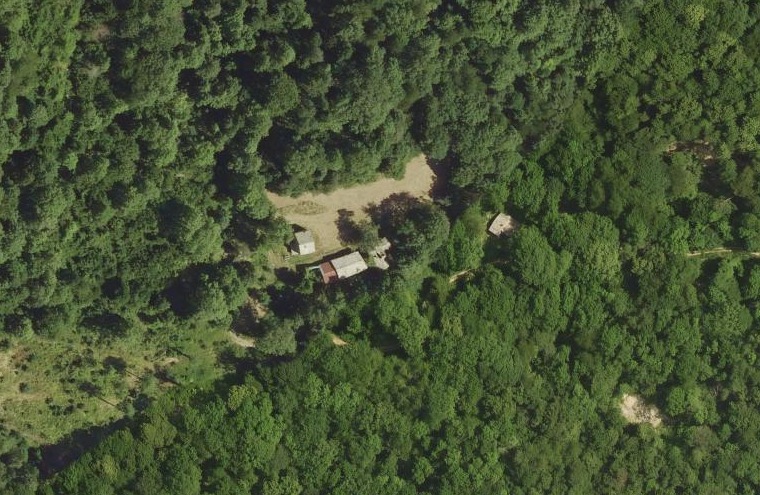
Daniela Girardengo and the Mendatica tourist office describe the Pilun de Scarette, the shrine where shepherds could turn with their flocks for either Poilarocca or Case Pian del Lago. At the latter they found tecci, the local stone herders’ houses, several restored using the original materials. An earlier village guide records a communal washing place there. In May 2019 Andrea Ferrando, who writes under the name l’Appenninista, found a spring by the houses and restored buildings alongside abandoned ones. In the aerial photograph, the trees come right up to the little clearing beside the roofs. It is easier to appreciate what a gift one more patch of ground would have been.
Check access with the park when planning a visit. On 20 June 2024 it published a temporary closure notice for works on the Arroscia Falls circuit, which includes Case Pian del Lago. The notice directs walkers to the park website for news of reopening.
Sources and further reading
- Federico Manera’s accounts of the families of Lago and the witches of Lago.
- Matteo Vinzoni’s map of 1748, detail on p. 22, fig. 1 and Mendatica’s municipal charter, art. 4.
- Il bianco della cenere, the community’s collection of memories. Lanteri and Ramella on the basure, vol. I, p. 41 and Catainin’s family and their apple fritters, vol. II, pp. 13–14. Guido Fregonese Beekeeping Museum on fixed-comb hives.
- Mendatica’s walking guide archived in 2008, Girardengo and the tourist office on the herders’ paths and a walker’s observations from May 2019.
-
The regional park’s description of the circuit and notice about access.
-
Explore further · Pian Rossello, where Mendatica drew its water · Montegrosso Pian Latte and the nights of the chestnut harvest
Photographs and credits
Cover. Mei du Lagu, a paper-cut interpretation of the heavily laden apple trees remembered by village elders. Created by mendatica.com with ImageGen. Federico Manera’s account
Case Pian del Lago from above, with north at the top. © AGEA, Agenzia per le Erogazioni in Agricoltura, 2022 survey. The editors joined the tiles and cropped the image, without adding labels. Aerial survey record · CC BY 4.0.
For a view from the ground, see Piero Pelassa’s photograph of the settlement in the park gallery.